Did you REALLY choose the food you’re currently eating, or was that curated for you? Is there ever a choice when it comes to food trends and our participation in them?
Remember the monologue by Miranda Priestly from The Devil Wears Prada about the cerulean sweater? How one “mindless” purchase comes from the accumulation of decisions made by multiple stakeholders in many rooms with hundreds of tireless conversations, in an industry that employs millions?
So, I ask: Do you think YOU choose the food you eat?
Well, grab your cerulean sweater- I mean, matcha, and let’s chat.
Before we dive deep into the trend forecasting methodologies and effects, let us first understand what a food trend is.
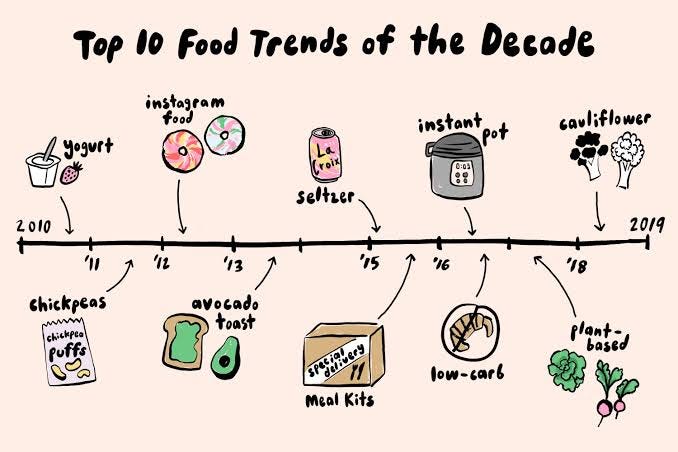
Food trends are the dynamic shifts in consumer preferences, behaviours, habits and consumption patterns within the food and beverages industry.
While they can be regional, most trends become ubiquitous through viral presence, changing what ingredients gain high demand on a global scale and shifting how menus are structured within the food services.
This phenomenon is a study deeply rooted in Consumer Science: which is the study of human behaviour and consumer needs, and creating solutions that provide need satisfaction (often inspiring repeat consumption behaviour).
My job is to tell you what you want, through psychological, emotional and economic persuasion.
My speciality is sustainable consumerism; a passionate dedication to an intentional and mindful approach to consumerism that reduces social and economic harm, while promoting localisation, through educating consumers in the hopes of empowering better agency.
Last time, we took a dive into the United Nation’s Sustainable Development Goals and what they entail.
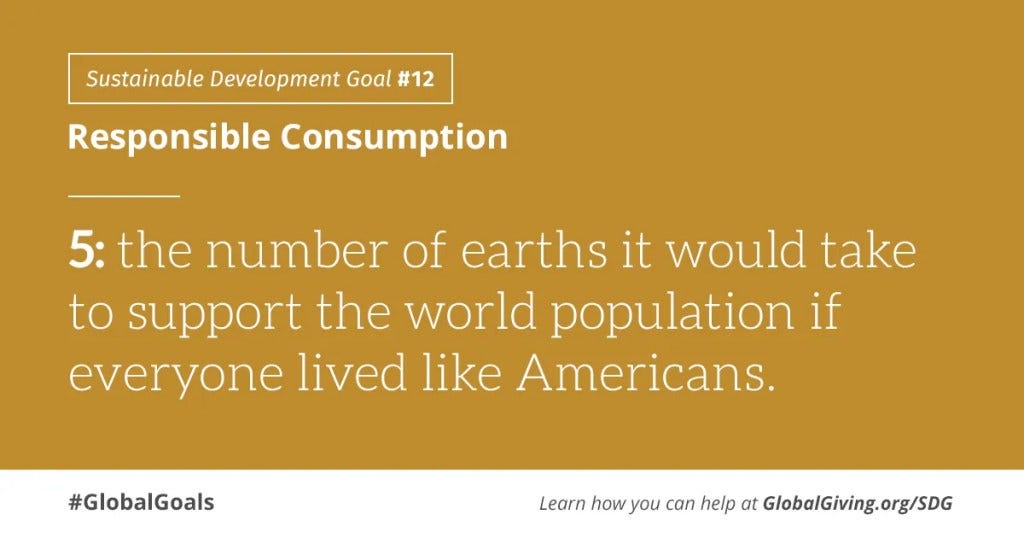
Today, we focus on Goal 12, which is about ensuring sustainable consumption and production patterns, as a key to sustaining the livelihoods of not just our generation but the next.
We know that due to a disproportionate distribution of resources, wars and inequalities, our planet is running out of resources while the populations continue to grow.
If we reach the estimated population of 9.8 BILLION by 2050, three earths will be required to provide natural resources needed to sustain our current lifestyles.
Which brings us back to the self-fulfilling prophecy of food trends and the paradox of choice.
Here’s a scenario:
A manufacturing company speaks on its acquisition for a high protein brand. Big Protein makes news with trade headlines writing on the size of prize. Start ups form on the opportunity. Influencers start talking about adding more protein into their diet. Trend forecasters predict a protein boom. It becomes the focal point for relevancy, everyone is mentioning protein. The drama show everyone watches at 7pm shows the main character talking about “protein maxxing”. It’s on every content creator’s “Top 10” list and suddenly the algorithm is all about protein.
See: Fiber and Protein Maxxing
Big Food Retail sees the scale of movement and starts Research and Development to build product ranges around protein, it’s now ubiquitous. Every industry conference panel, podcast and presentation is on the new alternative forms of protein. The cycle accelerates into YOU suddenly eating more protein (because everyone is doing it) and it begins to feed on itself.
This is the Thomas theorem, which says that if people define situations as real, they become real in their consequence. Self fulfilling prophesies become public confirmation, which is exactly how food trends work.
In the late 80’s sundried tomatoes became popularised, having a boom in the 90’s until they became dated.
Sushi became popular in the 80’s, shifting gaze from a Eurocentric lens and reshaping how people perceived Asian cuisine through more exploration (is that a miso brownie?)
Trends open the flavour portal across the globe and allow us to connect on shared consumption across diverse demographics.
Let’s consider a timeline of some food trends, for illustration.
In 2020, Kerry forecasted functional foods and ingredients as part of the trends, alongside elevated experience and food equality.
2021, Consumers wanted end-to-end sustainability and forecasted trends were conscious consumerism and health and wellness.
Fast forward to 2022, amidst the global cuisine curiosity post-lockdown, forecasts predicted sustainability nutrition, functional foods and the desire for provenance.
A resurgence of heirloom recipes came in 2023, with inflation driving a shift to permissible indulgence. More protein started emerging.
2024 saw an African Flavour revival, a renewed plantbased revolution and the use of bold and unusual flavour combinations.
The GLP-1 rise saw food trends in 2025 shifting towards little luxuries, functional ingredients and the bakery focus on added fibre and protein.
Which brings us to 2026,
Where hydration comes centre stage (so-called water stacking) due to increased fibre consumption. We also have the reclaim of cultural roots and heritage, and the boom of fibre-maxxing and protein-maxxing, which peaks across various categories, seeing an acquisition by PepsiCo for a prebiotic soda with inulin fibre- Poppi- to the value of nearly $2 billion.
So, what becomes of the resources when we demand-maxxing (yes, I made that up) our way through some of the food trends?
Unfortunately, when it comes to sustainability and being realistic- food trends are a self fulfilling prophecy towards the planet’s ruin, at least for the most part.
The ever growing cycle of new ingredients becoming a global sensation and the demand for the ingredient becoming a problem is ever so quick.
In 2025, we saw the sudden boom of “Dubai chocolate” lead to an international pistachio shortage, 4 years after the original was created. What became a ubiquitous iteration turned into a price hike, strained supply further affected by a poor harvest. Add in the need for high turnover leading to monoculture growth and increased artificial fertilisers and pesticides, and you can see the snowball effect.
Another staple become bougie consumable? Matcha. The humble tea from China, now grown in Japan, has seen a boom due to the rise of ingredient functionality and the growing trend of superfoods. In 2024, the German Tea Association recorded a whopping 240% increase in their procurement when compared to 2023. This does not even account for the global market expected to double in the next 7 years.
While many chase the highest grade of matcha, with the constant price hikes, this has had a detrimental impact on the people who used the product indigenously for tea ceremonies. Those who truly honour the plant are priced out, and the farmers who can’t keep up with the ever growing demand and resources are pushed out of business.
The people of Peru and Bolivia lived this dark sided reality after the United Nation’s Food and Agriculture Organisation declared 2013 the International Year of Quinoa. The aim was to highlight the grain for food security. It instead was sold as a superfood, sparked further by the food trends around superfoods, and consumption rose so rapidly that demand couldn’t be sustained. What was their staple, became a global commodity and the prices rose so sharply that they could hardly afford it anymore.
The soil also suffered, without sufficient time to recover, the increased chemical use and machinery creating compact soil. The high demand also caused cultivation on lands not meant for the plant, leaving the desert-like regions even less fertile- affecting the food supply of the Llamas. Again, you see the snowball.
Why does this mean anything to me and you?
Well, in 2023 we had the UN’s declared International Year of the Millet- grown indigenously in Africa and parts of Asia.
Which puts our already strained resources under the looming threat of capitalism as more of the grains, such as sorghum, become more present on the global food trend radar, and face the challenge of affordability for the indigenous people. Which is where I come in.
Now, listen, I am not saying we can’t have food trends- I have travelled the world without leaving my own land through the global cuisines and food trends.
I do however disagree that global trends should come at the peril of the local market and people- that the gatekeepers who kept the food alive are suddenly excluded from its market and the local farmers are cannibalised by big corporations.
If you remember, the first point of The Sorghum Agenda is to promote food sovereignty, by empowering local villages to own their land, invest in their farms and sustainably supply sorghum across the country, and beyond.
This means creating localised economies that centre the indigenous people for access, availability and affordability, and sustainable food systems that are not simply waiting for the next food trend.
The question of a sustainable food system requires far more conversation, that we will unravel next time.
The big idea, however, is moving agriculture from a monoculture focused food system for whatever the global market demands to one that enables farmers to produce food for local supply, with the international market then being considered from the lens of what is available for trade. Localisation as a primary focus through the lens of regional supply- heck, our carbon footprint will benefit for it.
We all have a role in creating a sustainable food system, we aren’t promised an outcome that necessarily meets our current consumerism- but that is not a bad thing, given that the current consumption patterns are straining our resources quicker than we can recover them.
It means farmers producing in accordance to the indigenous soil rotation, consumer scientists educating people on how to think about food trends more sustainably, consumers taking responsibility for their participation (your demand drives supply) in relation to the environment they exist within and the decolonialisation of the overall food system.
This is only the tip of the ice berg, and ahead of our next episode, I would like to invite you to send me your questions and comments. I will dedicate an episode to making sure YOU are also an active part of the conversation.